How Long Do USB Flash Drives Last? Retention, Rewrites and Giveaway Shelf Life
A procurement manager asks: "How long will these drives last?" The honest answer is not a number of years — it depends on what is inside, how often the drive is rewritten, and how it is stored. A drive handed out at a trade show and never touched again can still open in five years; a drive used as a daily backup will wear out on a different schedule. Here is how to judge it for your order, with checks you can run yourself. Temperature during use matters too: a drive left in a car glovebox through a summer sees both the heat and the disconnect stress, which is why "shelf life" and "in-use life" are different numbers.
What actually wears out inside a flash drive
Three parts age, and they age for different reasons. The memory cells (NAND) wear each time they are erased and rewritten — they have a finite program-erase budget. The controller manages that wear and can fail from interrupted writes or heat. The connector is purely mechanical: it wears from physical insertion, not from time. A "lifespan" question is really three questions, and only one of them is about the calendar.
Rewrite count matters more than age
A giveaway drive loaded once and read occasionally may sit unrewritten for years and stay readable — the cells never reach their erase budget. A daily-work drive rewritten every day burns through the same budget in months. The same physical drive has two completely different lifespans depending on use. When you order, the question to answer is not "how many years" but "how many rewrites," and that comes from how the recipient will use it. This is also why the endurance figure on a datasheet is a write-count, not a calendar count — manufacturers specify total bytes written, not a number of years.
Three habits that shorten life
Most early failures come from handling, not from the parts themselves. The diagram below maps each habit to the part it damages:
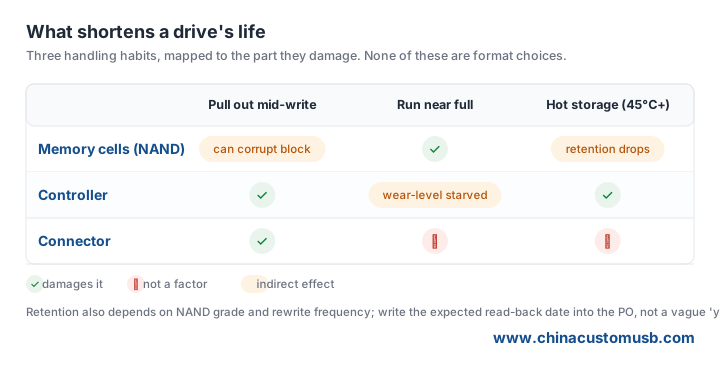
Pulling the drive out mid-write can corrupt a block and interrupt the controller's firmware — always use eject. Running the drive near full starves wear-levelling and wears the same cells faster. Hot storage (above roughly 45°C) accelerates charge leakage in the cells and shortens retention even when the drive is unplugged. None of these are about the file system you choose; FAT32, exFAT, and NTFS wear the cells the same way, so format choice affects compatibility, not lifespan.
A read-back test buyers can run on a sample
Before placing a bulk order, ask for one sample and run a read-back after a set interval. Write a known file, note its checksum, store the drive as you expect (shelf, not oven), then read it back after 30, 90, and 180 days and compare hashes. If the hashes hold, retention is fine for that storage condition. Store the sample in the same box and climate as the bulk shipment, not in a climate-controlled drawer, or the result will not predict the field. This turns "how long" into a measured number for your exact use case instead of a vendor claim.
What to write into the PO when the drive must still open later
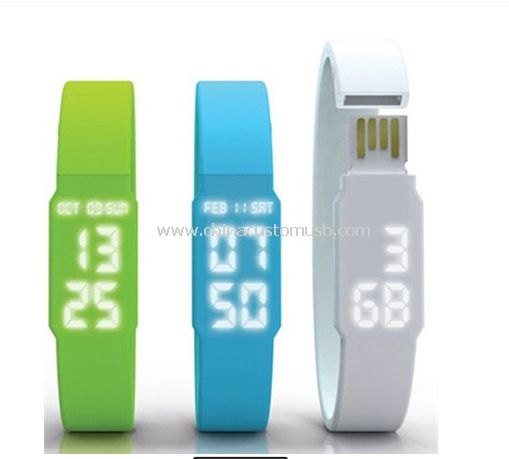
If the drive must still open two years later — say a warranty manual or a product catalogue — specify it in the purchase order, not in conversation. State the file types, how often the drive will be rewritten (never, monthly, daily), and the longest storage temperature. That lets the factory match a NAND grade and controller to the job instead of shipping the cheapest default. If two suppliers quote the same capacity at very different prices, the cheaper one is often the one shipping lower-grade NAND — ask which grade, and confirm with the read-back test. For a giveaway that must survive on a shelf, a sealed novelty body like the one below keeps the connector clean and the drive readable:
Order against the use case, not a year count
Send us how the drive will be used — file types, rewrite frequency, and how long it must stay readable — and we will quote a matching controller and NAND grade, sample first. Write the read-back target into the PO so the factory is held to your condition, not a generic "years" claim. As a rule of thumb, a drive rated for a few thousand program-erase cycles at ten writes a day lasts far longer than the same drive rewritten a hundred times a day — put the expected write rate in the PO and the factory can pick the right grade.
Need custom USB drives for your next project?
Factory-direct pricing, free digital proof and a 7-day sample turnaround.
Get a free quote


