Can I Get a Sample Before a Bulk USB Order? What Is Free, What Is Charged
Most buyers who type "can I get a sample before a bulk USB order" are not asking out of curiosity. They have a logo, a capacity, and a delivery date, and they want to hold the physical unit before committing to tooling and a few hundred units. The short answer is yes — in almost every case you can see a sample first. The useful answer is that "a sample" is three different things, and which one you ask for changes what it costs and how long it takes.
Three kinds of sample — and the question each one answers
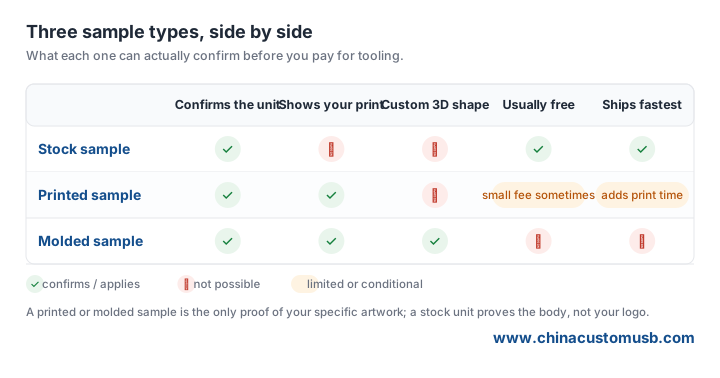
A stock sample is a unit pulled from existing inventory, usually in a standard shape with no printing. It answers one question only: is this the body style I want? If you are still choosing between a swivel, a credit-card shape, and a leather casing, a stock sample settles the shape in your hand.
A printed sample is a stock body with your logo or artwork applied by the same process used in production — laser, UV, or silkscreen. It answers: will my print look right on this surface? This is the sample most buyers actually need, because print is where expectations break.
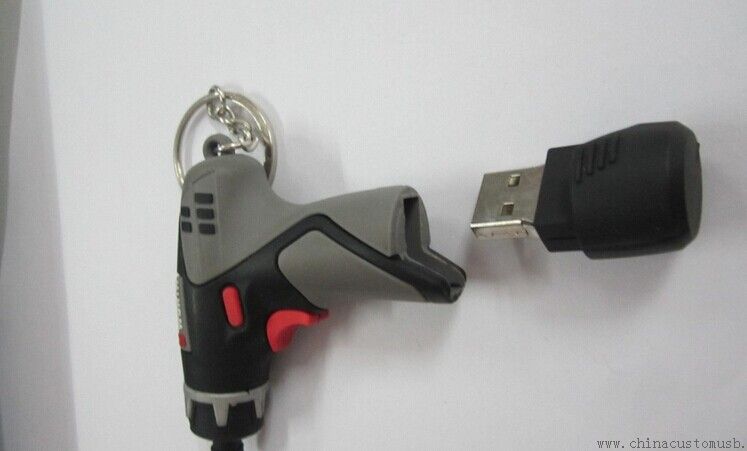
A molded sample is a custom 3D shape built from a new mold, like the electric-drill-shaped PVC body below. It answers: can you make this exact shape? Molded samples exist only when the product itself is custom, and they are the most expensive and the slowest of the three.
What is normally free, what is normally charged
Stock samples are normally free apart from shipping. Printed samples are often free for simple single-process artwork, but a small fee may apply when the artwork needs setup that production would also need — a two-colour silkscreen or a full-bleed UV print, for example. Molded samples are charged, because cutting a new mold is a real cost that production amortises only across the bulk run.
The standard handling is a credit against the bulk order: the sample fee is deducted from the final invoice once you place the order above a stated quantity. Ask for that in writing before the sample ships, because the threshold varies by product and by how much tooling the shape needs. If a supplier will not state the credit threshold, treat that as a reason to slow down, not to pay faster.
Shipping a sample: who arranges it, and what the courier changes
You normally arrange and pay for sample shipping, and the courier you pick decides the wait more than the factory does. A local postal service can take one to three weeks and gives weak tracking; a courier such as DHL or FedEx typically delivers in three to seven business days with full tracking. For a single sample the courier fee often exceeds the sample cost, so the courier choice is where the real money and the real delay live.
Give the factory a deliverable address and a working phone number at the start. Customs on a sample valued at a few dollars is rarely an issue, but a missing phone number on the waybill is a common reason a parcel sits in a hub. If you need the sample by a fixed date — a trade show, a client meeting — state the date in the sample request and confirm the courier against it.
Five checks the moment the sample lands
Do not file the sample away. Run five checks the day it arrives, because this is the cheapest point to catch a problem:
- Capacity — plug it in and verify the usable space matches what you ordered. A 16GB drive should show roughly 14.5–15GB usable after formatting overhead; a drive reporting far less is a red flag.
- Read and write speed — copy a file both ways. A drive that stalls on a single 1GB copy is a drive your end users will complain about.
- Print placement and colour — hold it next to your brand guide. Check the logo sits where the proof said and the colour is not shifted.
- Connector and body — confirm USB-A or USB-C, and that the cap, swivel, or slider moves the way you expect.
- Preloaded content — if you asked for files preloaded, open them on a second machine to confirm they are readable, not just present.
Photograph the sample against a ruler and a colour reference card, and keep the courier label. Those photos are your record if the bulk run drifts from what you approved, and they are far easier to defend than memory six weeks later.
From approved sample to production: what the golden sample locks
Once you sign off, the approved sample becomes the "golden sample" — the physical standard the bulk run is measured against for body, print, and capacity. Lock it in writing: the golden sample defines the print position, the colour approved, and the capacity, and production is checked against it.
What it does not lock is everything outside the physical unit. Delivery dates, carton quantity, and any preload content are contract terms, not properties of the sample. The sample proves the product; the purchase order proves the rest. Keep the two separate, and the bulk order stops being a leap of faith.
Tell us the body, capacity and print you have in mind plus where the sample should ship; we will confirm which sample type applies and what it costs before anything goes into production.
Need custom USB drives for your next project?
Factory-direct pricing, free digital proof and a 7-day sample turnaround.
Get a free quote


