Importing USB Flash Drives from China: 5 Steps From Factory Gate to Your Warehouse
When you import USB flash drives from China, the unit price on the proforma invoice is only part of what you pay. The rest is international freight, marine insurance, import duty, and the customs broker's fee — and which of those you absorb depends entirely on the Incoterm printed on the quote. Get it wrong and a "cheap" 5,000-piece order can arrive at your dock with a four-figure customs bill you never budgeted for. This guide walks through the five decisions that turn a factory-gate price into a delivered cost you can actually defend to your finance team.
Start With the Incoterm, Not the Unit Price: EXW, FOB and DDP
The single line that decides your landed cost is the Incoterm, and most first-time importers skip it because the unit price looks fine. Three terms cover the vast majority of promotional USB orders.
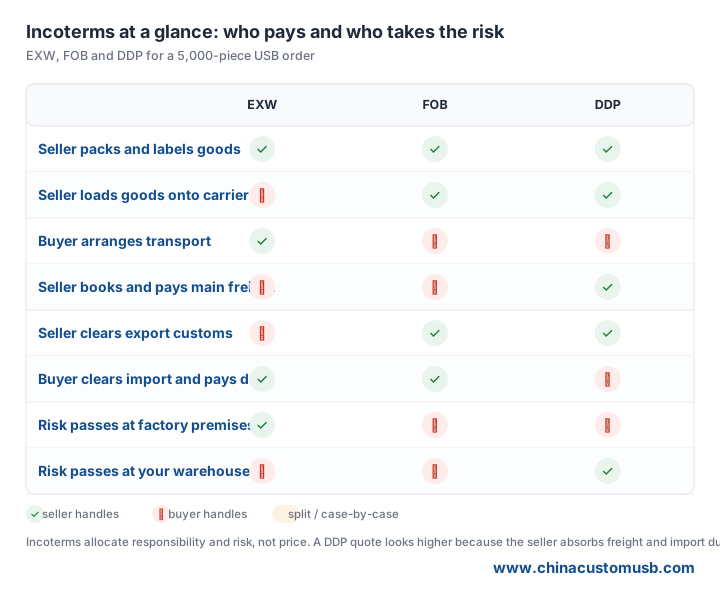
EXW (Ex Works) means the factory makes the goods available at its dock in Shenzhen and nothing more. You arrange pickup, export clearance, ocean freight, insurance, import clearance, and final delivery. It gives you the lowest headline price but the most moving parts — and the most places to miscalculate.
FOB (Free On Board) means the seller delivers the goods loaded onto the vessel at the named port, usually Yantian or Shekou. The seller handles export clearance and the inland move to the port; you pay the ocean freight, insurance, and all import-side costs. This is the default for most B2B buyers because it keeps the freight negotiation in your hands.
DDP (Delivered Duty Paid) means the seller takes the goods all the way to your warehouse, duty and tax included. The unit price is highest, but there are no surprises: one invoice, one party responsible end to end.
The table below maps who actually carries each task under the three terms.
If you are importing for the first time and do not have a freight forwarder, DDP removes the most risk. If you already ship containers regularly, FOB usually wins on total cost because you control the freight contract.
Which Shipping Mode Fits 500 Drives and Which Fits 5,000
The second decision is how the cartons physically move. The right answer is a function of quantity and how fast you need them.
Courier (DHL / FedEx / UPS) for under about 500 pieces. A small parcel of a few hundred drives arrives door-to-door in 3–7 days with no separate customs broker required for low-value shipments in most countries. Simple, predictable, and the safest choice for a first trial order.
Air freight for about 500–2,000 pieces. Once courier rates climb past the practical ceiling, a consolidated air shipment to your nearest airport cuts transit to a few days while keeping handling simple. You then arrange truck delivery from the airport.
Sea freight (LCL then FCL) for 5,000+ pieces. A 5,000-piece run of standard drives fills a few cartons that share a container as LCL (less than container load). Once your order approaches roughly 15,000–20,000 pieces, a full 20-foot container (FCL) becomes cheaper per unit. Ocean transit runs about 18–25 days to the US West Coast and 28–35 days to Europe; air is 3–7 days but several times the cost.
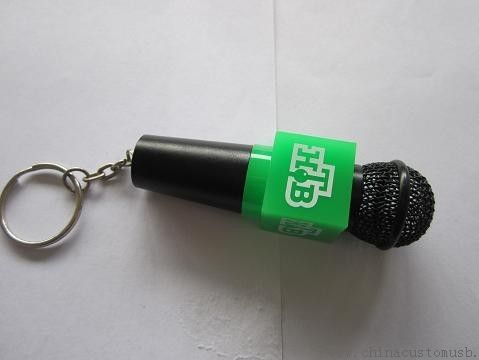
A custom-shaped promotional drive like the one below packs and palletizes the same way as a standard stick — the shape changes tooling and unit price, not the shipping math.
Rule of thumb: if the drives must be in hand within two weeks, do not quote sea freight. If you have a month and a full container's worth of volume, sea is almost always the lowest landed cost.
Documents the Forwarder Asks For (and the One Buyers Forget)
Before cartons move, your forwarder needs a short paper trail. The standard set is a commercial invoice, a packing list, and a bill of lading for sea or an air waybill. For electronics you also need the HS code — USB flash drives commonly fall under tariff heading 8523.51 in many systems — plus the CE, FCC, and RoHS compliance documents that prove the goods meet market requirements.
The document buyers forget is the HS code paired with a correct declared value. Under-declaring to "save" duty is the fastest way to get a shipment seized or a permanent flag on your importer record; over-declaring just wastes cash on duty you do not owe. Send the forwarder the exact HS code and the true transaction value before the goods are packed, not after.
Building the Landed Cost: Goods, Freight, Duty and Clearance
Landed cost is what the drives actually cost once they sit in your warehouse. The formula is straightforward.
Landed cost = goods value + international freight + insurance + import duty + VAT/GST + customs broker fee + local cartage.
A concrete example for 5,000 drives at a $1.20 unit (goods = $6,000): LCL ocean freight runs roughly $350–$450 to a major port; insurance at about 0.3% of goods value is around $18; the customs broker charges a flat fee, often $50–$150 per entry; local trucking from port to warehouse might be $60–$120. Import duty on USB memory is 0% in a number of countries but varies — verify your own HS rate rather than assuming. At 0% duty the same order lands near $6,550; at a 3% rate, about $200 more.
The point is not the exact figure — it is that every line is knowable before you commit. Ask for FOB and DDP quotes side by side and the freight and duty lines stop being a mystery.
A Pre-Shipment Checklist Before the Cartons Leave Shenzhen
Once the order is confirmed, lock these down before the factory seals the cartons.
- Confirm the Incoterm in writing and who books the freight.
- Send the forwarder the HS code and the true declared value early.
- Request pre-shipment photos, carton count, and gross weight.
- Agree carton marking and palletization if shipping LCL.
- Confirm CE / FCC / RoHS documents are attached to the shipment.
- Lock the delivery address and a named customs receiver contact.
None of these are difficult, but each one skipped is a delay or a fee that lands after the fact. A five-minute checklist call before shipping beats a week of emails after the container sails.
Send your delivery city and drive quantity, and we will quote FOB Shenzhen and DDP side by side so you can compare landed cost before you commit a single carton.
Need custom USB drives for your next project?
Factory-direct pricing, free digital proof and a 7-day sample turnaround.
Get a free quote

