CE, FCC and RoHS Paperwork for a USB Drive Order: 5 Documents to Request
A USB flash drive is not a simple commodity once it crosses a border. In the EU it is regulated electronics; in the US the FCC treats it as an "unintentional radiator"; and both regions restrict hazardous substances in the plastic shell and the solder. None of this blocks a legitimate order - but it does mean you should collect the right documents before you release payment, not after a customs hold or a procurement-portal rejection. Here are the five papers to request for a custom USB order.
Why a Custom USB Order Needs Paperwork at All
The importer is responsible for placing compliant product on the market, so the documents are your evidence that the specific model you ordered meets the rules in the country you are shipping to. A drive with no paperwork can be stopped at the border, pulled by a distributor, or rejected by a corporate buyer's compliance portal. Request the papers per model number and per production lot, not per supplier name - a generic folder from the factory will not match your SKU when an inspector asks. The cost of asking up front is one email; the cost of asking after a hold is a stopped shipment.
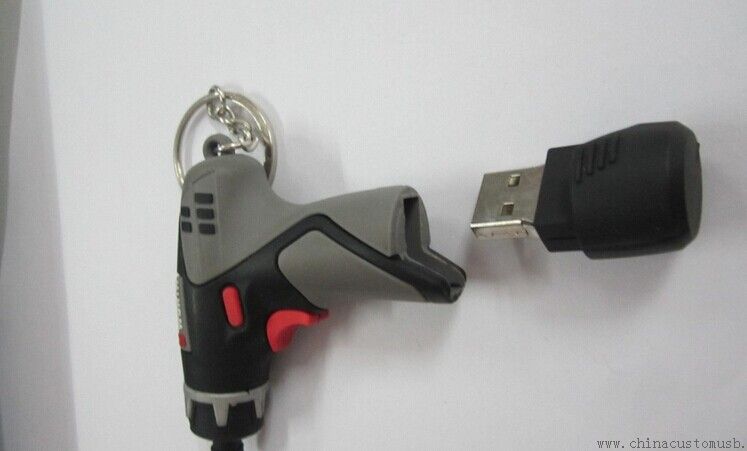
For a custom-shaped drive the model identity matters even more. A PVC drill-shaped body in 8GB is a different SKU from the same shape in 16GB, and the Declaration of Conformity must name the exact configuration you are importing. Lock the model number with your supplier before you ask for the documents, so every paper points at the same product.
The Declaration of Conformity: What It Should Name
In the EU, the Declaration of Conformity is the supplier's signed statement that the product meets the applicable directives. For a plain flash drive without wireless radio, the relevant frameworks are typically the EMC Directive, the Low Voltage Directive (or the General Product Safety Regulation), and the RoHS Directive. The document must name the exact model, the manufacturer and its address, the standards applied, and the year it was issued. Watch for a DoC that lists only "USB flash drive" in general terms - it will not match your SKU at customs, and a compliant-looking but mismatched document is worse than none because it gives false assurance.
FCC: Treating a Flash Drive as an Unintentional Radiator
In the United States the FCC regulates devices that emit radio-frequency energy. A passive USB flash drive has no transmitter, so it falls under Part 15 Subpart B as an "unintentional radiator". Compliance is shown with an FCC Supplier's Declaration of Conformity (SDoC) and the standard Part 15 notice in the user manual and on the packaging. There is no FCC ID for an unintentional radiator - that identifier is for intentional radiators such as Wi-Fi or Bluetooth modules. So for a plain drive, request the SDoC and the underlying test report, and confirm the Part 15 statement is present on the product literature.
RoHS and REACH: Which Report, Which Date, Which Part
RoHS restricts substances - lead, mercury, cadmium, hexavalent chromium, PBB, PBDE, and the four phthalates added in the later amendment - in the homogeneous materials of the drive: the PCB, the plastic shell, and the connector. Request a RoHS test report dated for the production lot, showing the limit and the measured result for each material. REACH is broader: ask for a REACH statement, often an SVHC declaration, covering the substances on the current candidate list for the parts you care about. The two are different documents - RoHS sets substance limits by directive, REACH is the candidate-list declaration - so request both, and note the issue date so you can confirm it covers the version in force when you import.
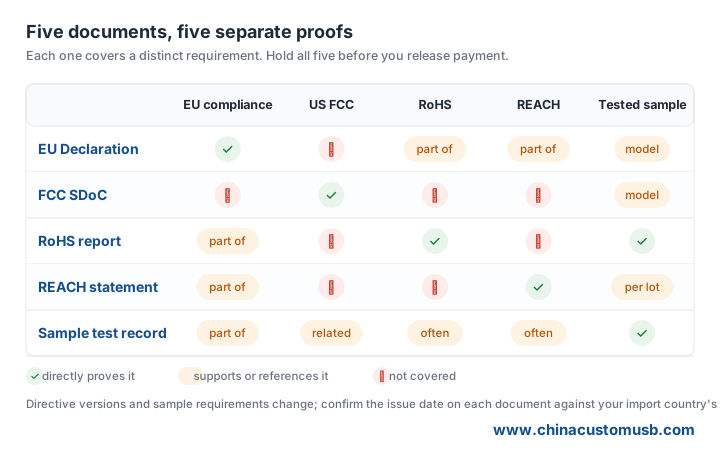
Five Documents to Collect Before You Release Payment
Collect these five and file them by model and lot date before you release the balance of payment: (1) the EU Declaration of Conformity naming your exact model; (2) the FCC SDoC with the Part 15 notice; (3) a lot-dated RoHS test report with measured values per material; (4) a REACH or SVHC statement for the current candidate list; and (5) a sample test record or material declaration you can hold against a future complaint. Keep them with the purchase order so a customs query or a buyer audit is a five-minute lookup rather than a scramble.
Send us your compliance checklist and the country you are importing into, and we will come back with the exact document set we can supply for the drive you are quoting.
Need custom USB drives for your next project?
Factory-direct pricing, free digital proof and a 7-day sample turnaround.
Get a free quote

